
Case Study II
Lumen Davies
The proposed mixed-use building at 39–47 Davies Avenue, Toronto, Ontario, is designed as a six storeys structure above ground with two underground levels. Vehicular access is carefully located along Davies Avenue to minimize conflicts with pedestrian activity and to preserve the park edge as a primarily pedestrian-oriented environment. Situated directly beside Joel Weeks Park, the project occupies a critical threshold condition between the city and a public green space.
Rather than functioning solely as an office building, the project is conceived as a spatial mediator that negotiates the contrasting conditions of urban density and open landscape. The architectural strategy seeks to soften this transition by shaping the building as an extension of the park, allowing light, air, and views to move freely between interior and exterior spaces. Through its form, orientation, and spatial organization, the building responds to both the city and the park, establishing a dialogue that enhances the experience of each.
Details
2 Floors
Parkside Commercial Building
2025 / Toronto, Canada
Multi-used Commercial Development

The site plan was developed to strengthen the physical and visual connection between the building and Joel Weeks Park, translating the project’s mediating role into a clear site strategy. The park edge is preserved as a predominantly pedestrian-oriented zone, allowing uninterrupted movement and safer public use along the green space.
Building massing is pulled back from the park to enhance permeability, visual openness, and continuity of the surrounding landscape. This setback strategy also improves sightlines across the site, reinforcing the park’s presence within the urban context.
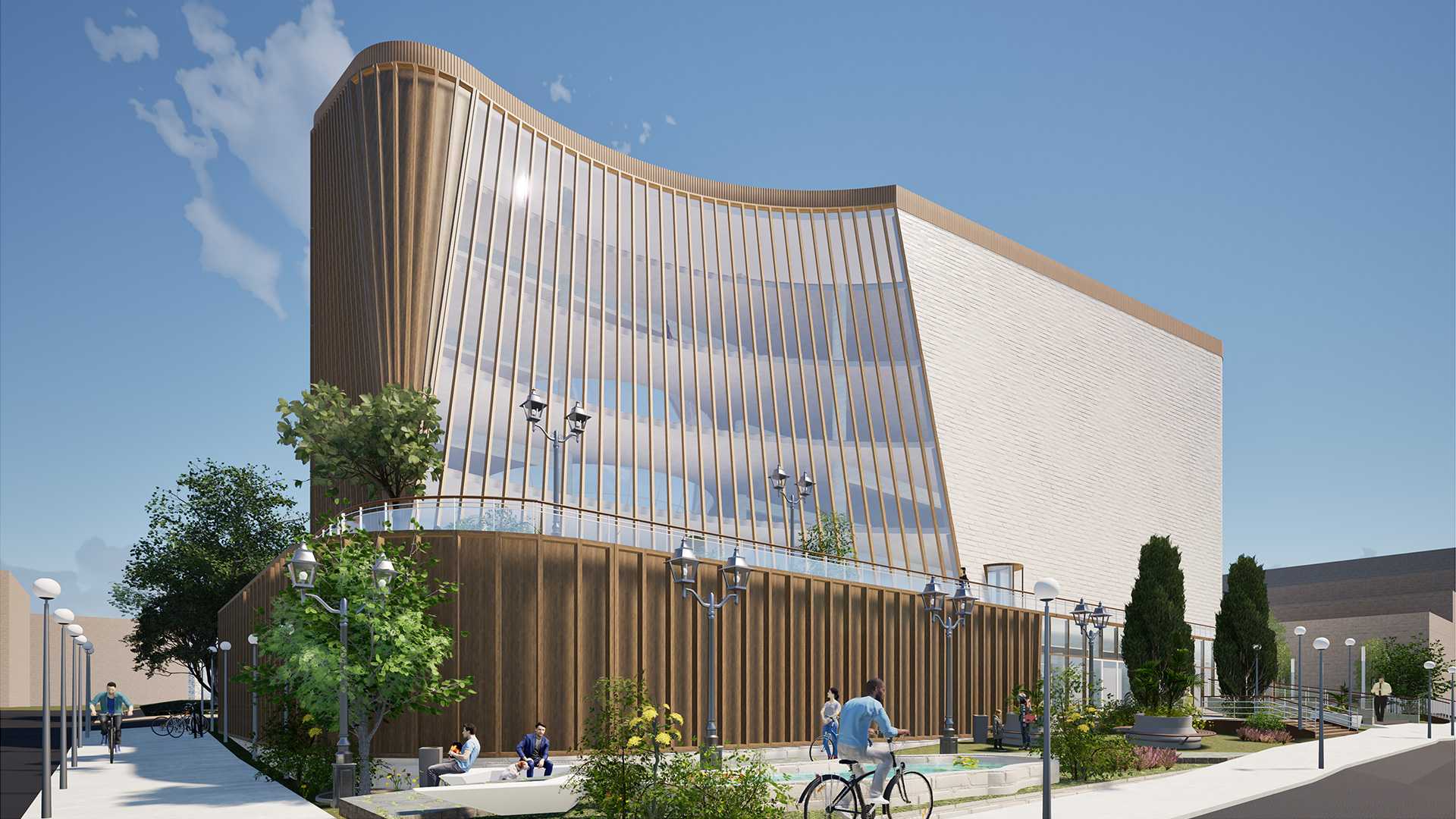


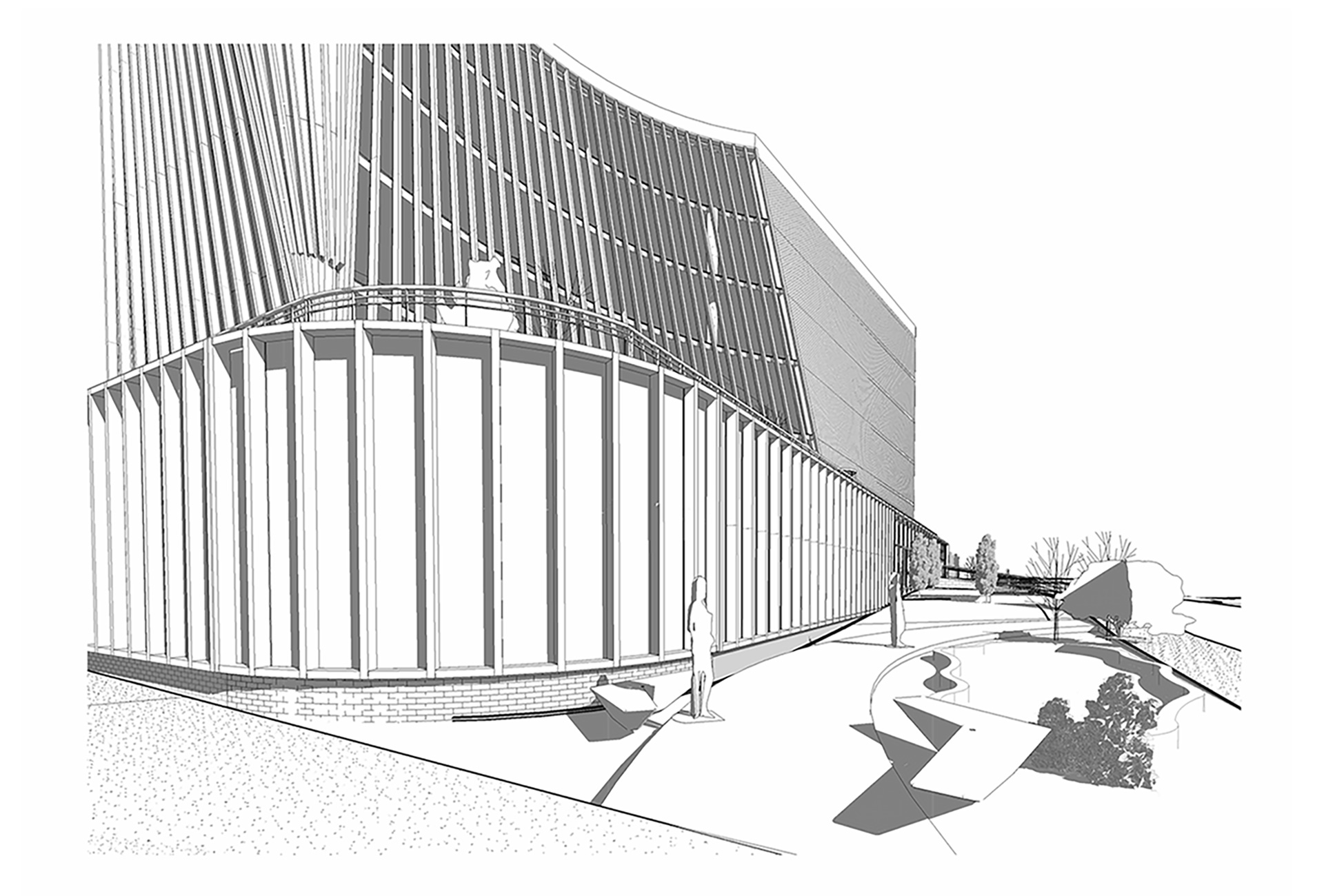
The landscape design extends the park’s greenery into the building through layered planting, green roofs, and soft topographic transitions. Outdoor terraces and planted roof surfaces blur the boundary between architecture and landscape, encouraging public engagement and passive use.
These landscape elements contribute to microclimate control by reducing heat gain and improving air circulation around the building. Seasonal planting and varied surface treatments further enhance sensory experience and ecological performance throughout the year.

The building form is generated through the subtraction of spherical and cylindrical volumes, creating a soft and fluid architectural language. Inspired by sculptural precedents such as the Elbphilharmonie, the massing avoids sharp edges and instead emphasizes continuous curvature.
This approach establishes a landmark presence while maintaining a human-scaled relationship with the adjacent park. The resulting form allows the building to be perceived differently from multiple viewpoints, reinforcing its sculptural quality within the site.


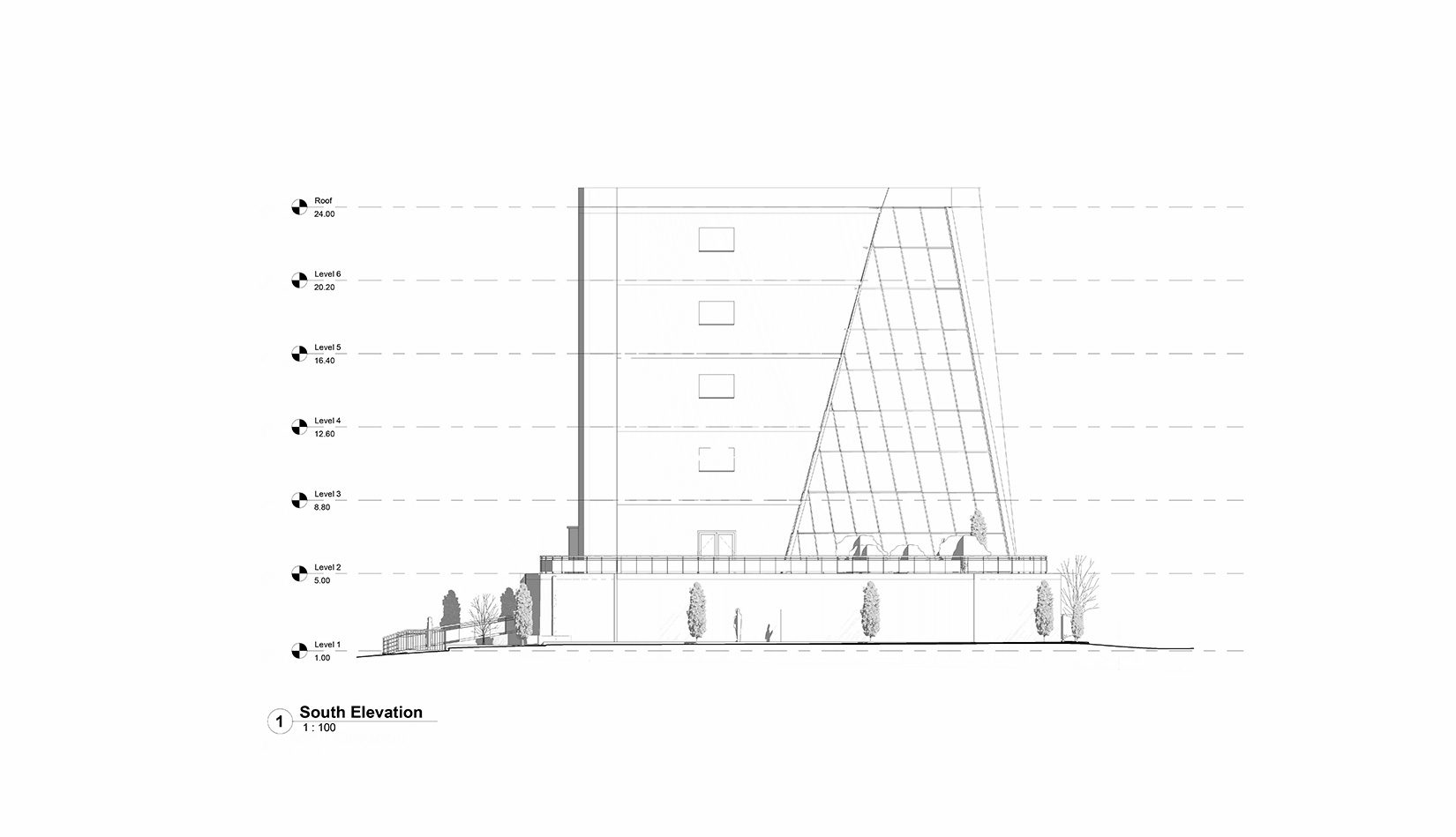
South Elevation
The south elevation addresses the intensity of sunlight and urban exposure through deeper facade articulation and curvature.
These design moves help moderate solar impact while maintaining a coherent architectural expression across the building envelope.
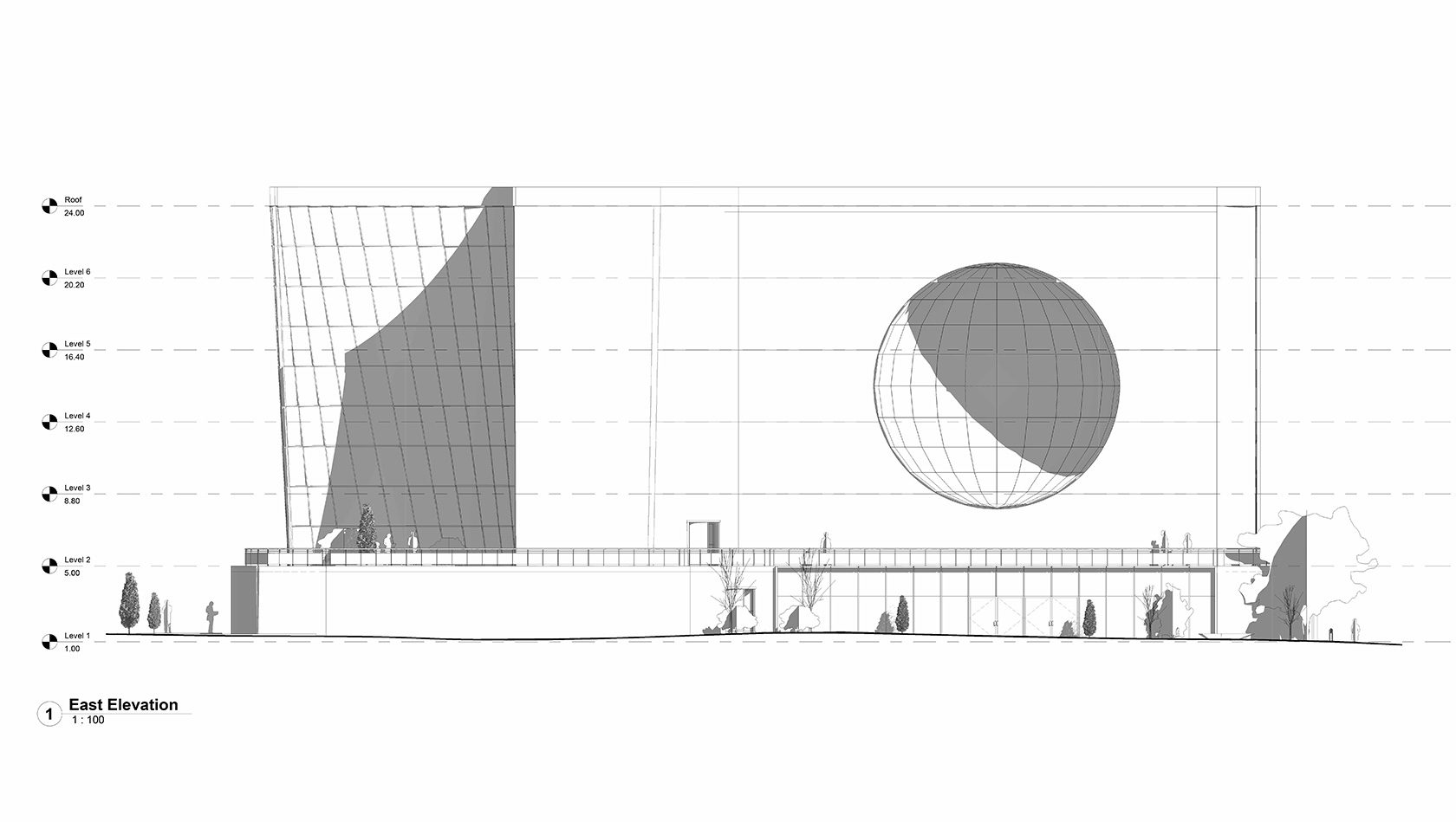
East Elevation
The east elevation employs a more transparent façade treatment to frame views toward adjacent open spaces and the surrounding urban context.
Controlled glazing proportions balance openness and privacy while allowing consistent daylight penetration along the building edge.
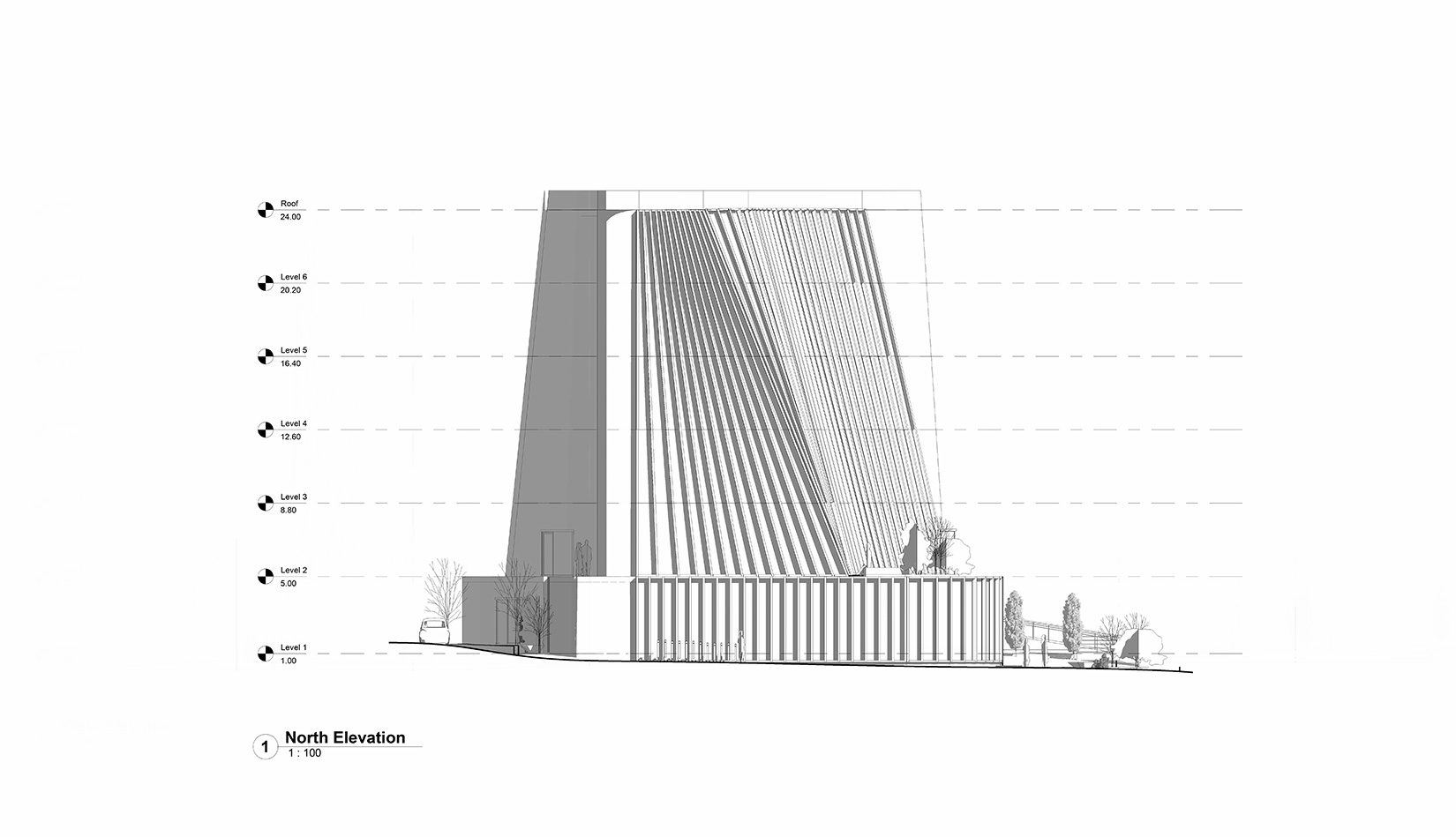
North Elevation
The north elevation is oriented toward Joel Weeks Park and is designed to establish a strong visual and spatial relationship with the surrounding landscape.
Its softened geometry and strategic openings create a welcoming facade that responds to pedestrian scale and reinforces the building’s connection to the park.
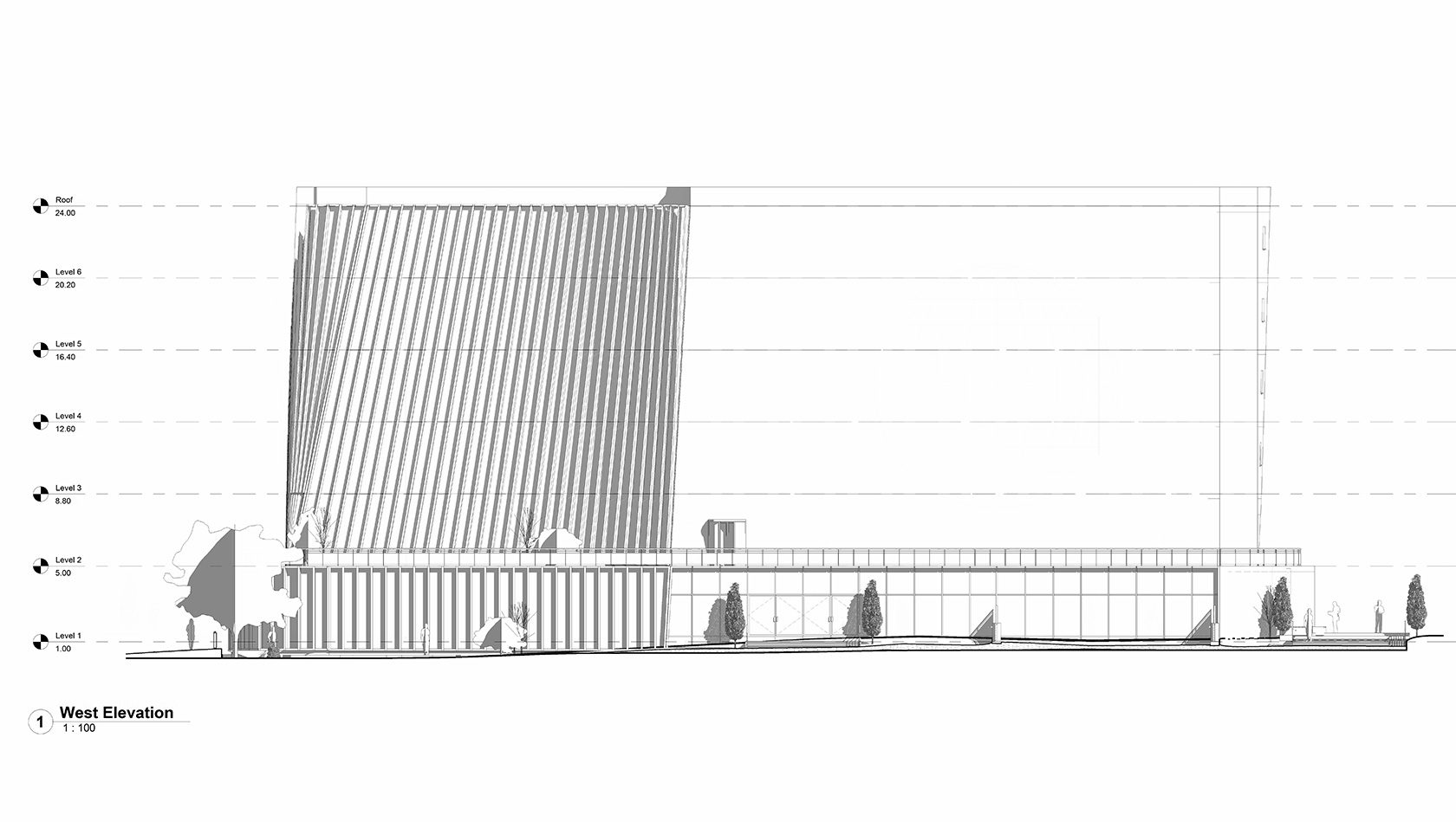
West Elevation
The west elevation responds to the adjacent highway and vehicular movement with dynamic, flowing curves that express motion and infrastructure-driven forces.
This facade acts as a protective and expressive layer, establishing a strong landmark presence when viewed from a distance.
Sectional design is employed as a key tool to optimize natural light penetration and air movement throughout the building. Curved surfaces and stepped volumes guide daylight deep into interior spaces while minimizing shadows cast onto the adjacent park.
Vertical voids and sectional openings support passive ventilation, reinforcing the building’s environmental responsiveness. This sectional approach allows environmental performance to be integrated directly into the spatial organization of the building.
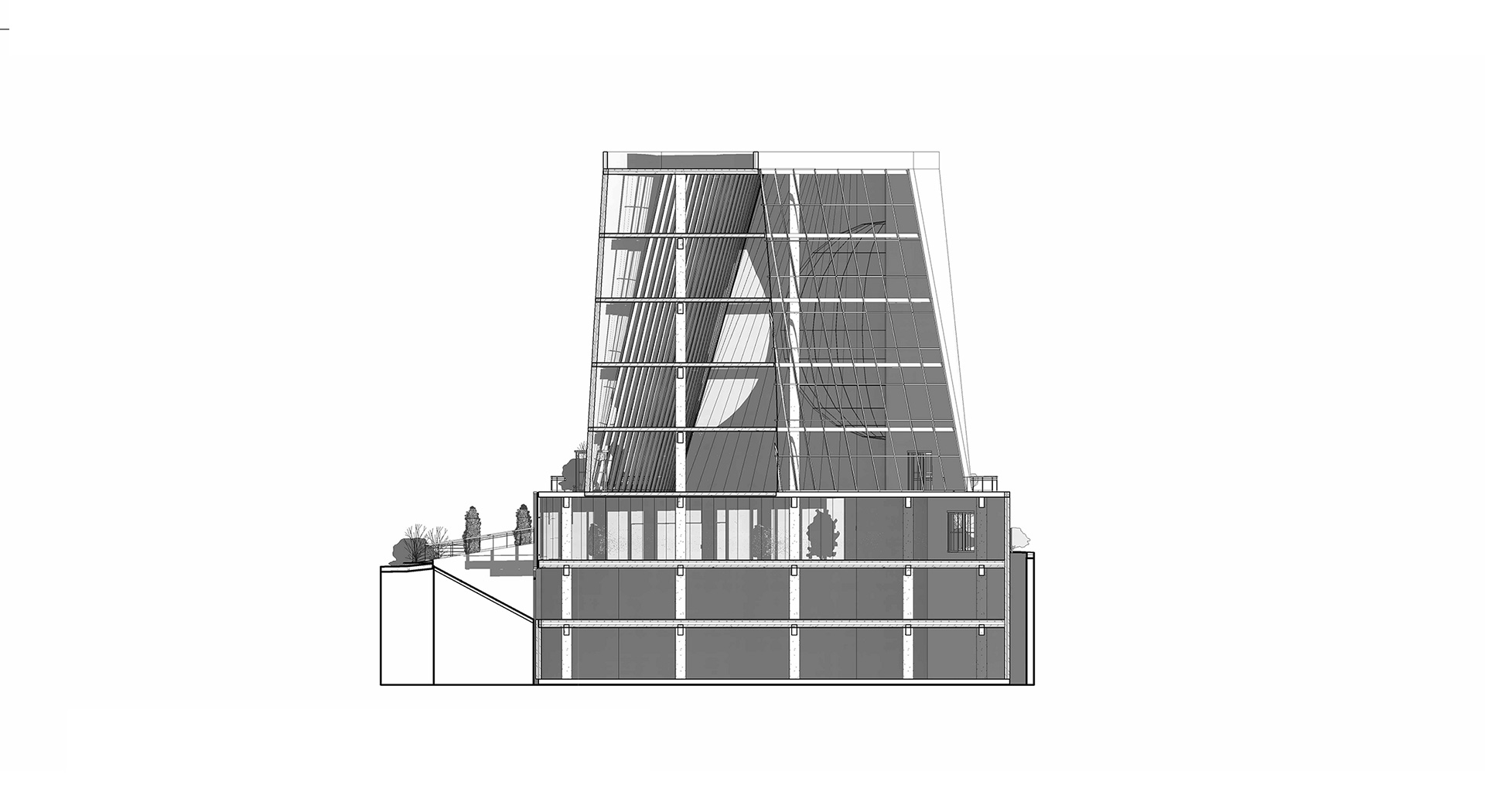

Interior spaces are organized to maximize visual and physical connections to the surrounding park landscape. Large glazed surfaces frame views while allowing daylight to shape interior spatial experiences throughout the day.
The building operates as an extension of the park, integrating light, air, and landscape into everyday interior environments. Transitions between interior and exterior spaces are designed to feel gradual, reinforcing a continuous relationship between architecture and nature.




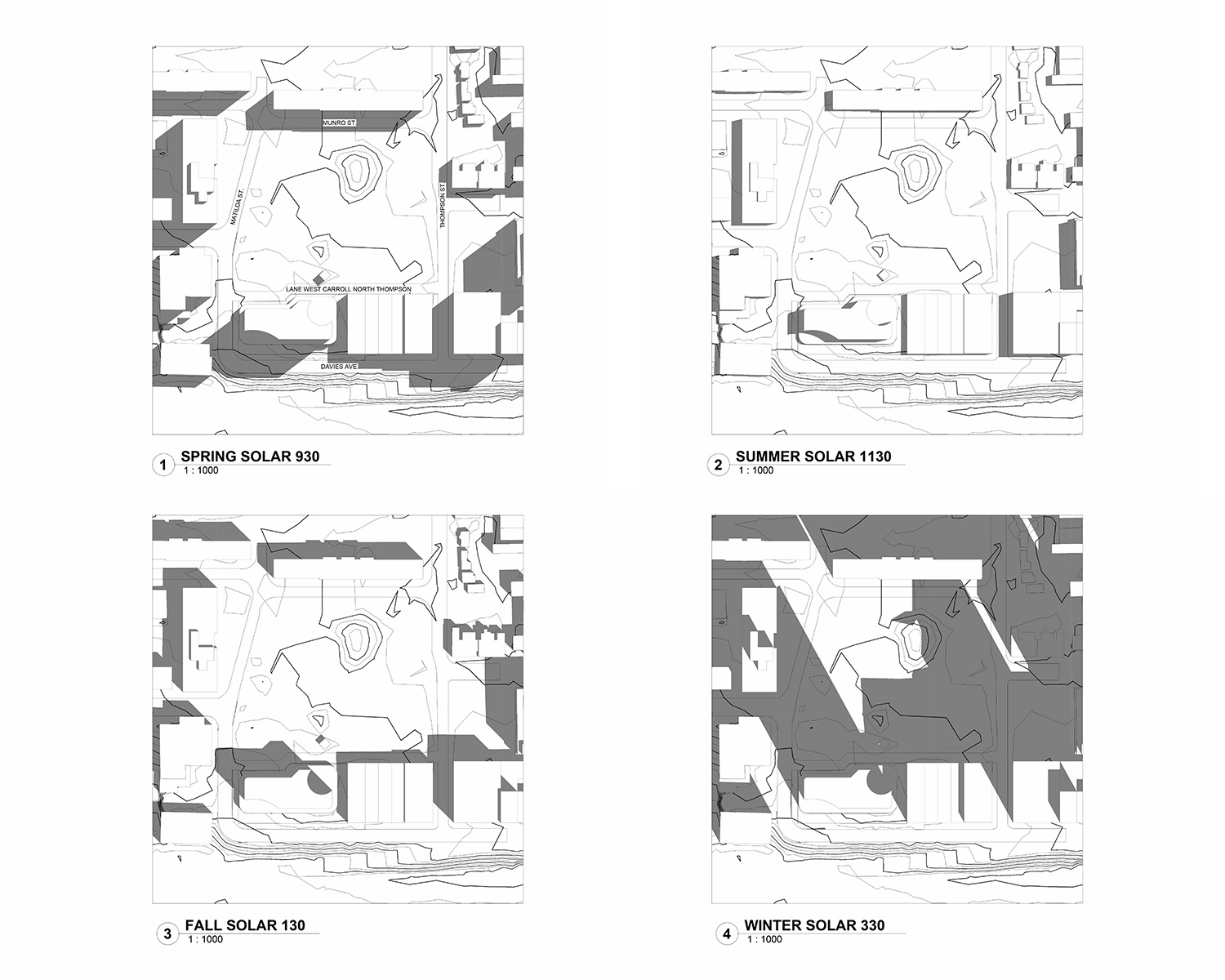
The The proposed sustainability targets are derived from a balanced consideration of design intent, material logic, and realistic architectural application. While the building employs a curved curtain wall system and a composite facade, making full reliance on sustainable materials impractical, conscious material choices such as recycled aluminium framing, high-performance glazing, and locally sourced low-carbon finishes support a strong level of material sustainability.
The building’s deeply recessed forms, proximity to green space, and emphasis on passive design strategies reduce reliance on mechanical systems without claiming full net-zero performance. In addition, the use of repetitive curved modules, rationalized structural logic, and systemized facade components allows for reduced construction waste through prefabrication and modular coordination, making the proposed sustainability metrics both credible and design-driven.
Project Info
This academic project was developed as a conceptual mixed-use building study exploring the relationship between architecture, public space, and environmental performance.
The project focuses on how building form, facade articulation, and sectional strategies mediate between urban density and an adjacent park condition. Emphasis was placed on integrating natural light, air movement, and landscape continuity to create a user-oriented architectural proposal.
Academic Project
Completion: November, 2025
Project Type: Mixed-Use / Office & Public Interface
Architects: Jin Choi
Project Sustainability
- 55% Sustainable Materials
- 65% Energy Self-Sufficient
- 30% Less Construction Waste
Other Projects
Residential
The Grove Residence
Toronto, Canada
Barrier-free Building Design
commercial
Young Street Mall
Busan, Korea
Multi-Functional Shopping Centre
Interior
Cafe & Retail Interior
-The Gate Cafe, “Oasis in The City”
-The Gate Cafe, “Journey in The City”
-Miig, Urban Active-wear Retail Shop